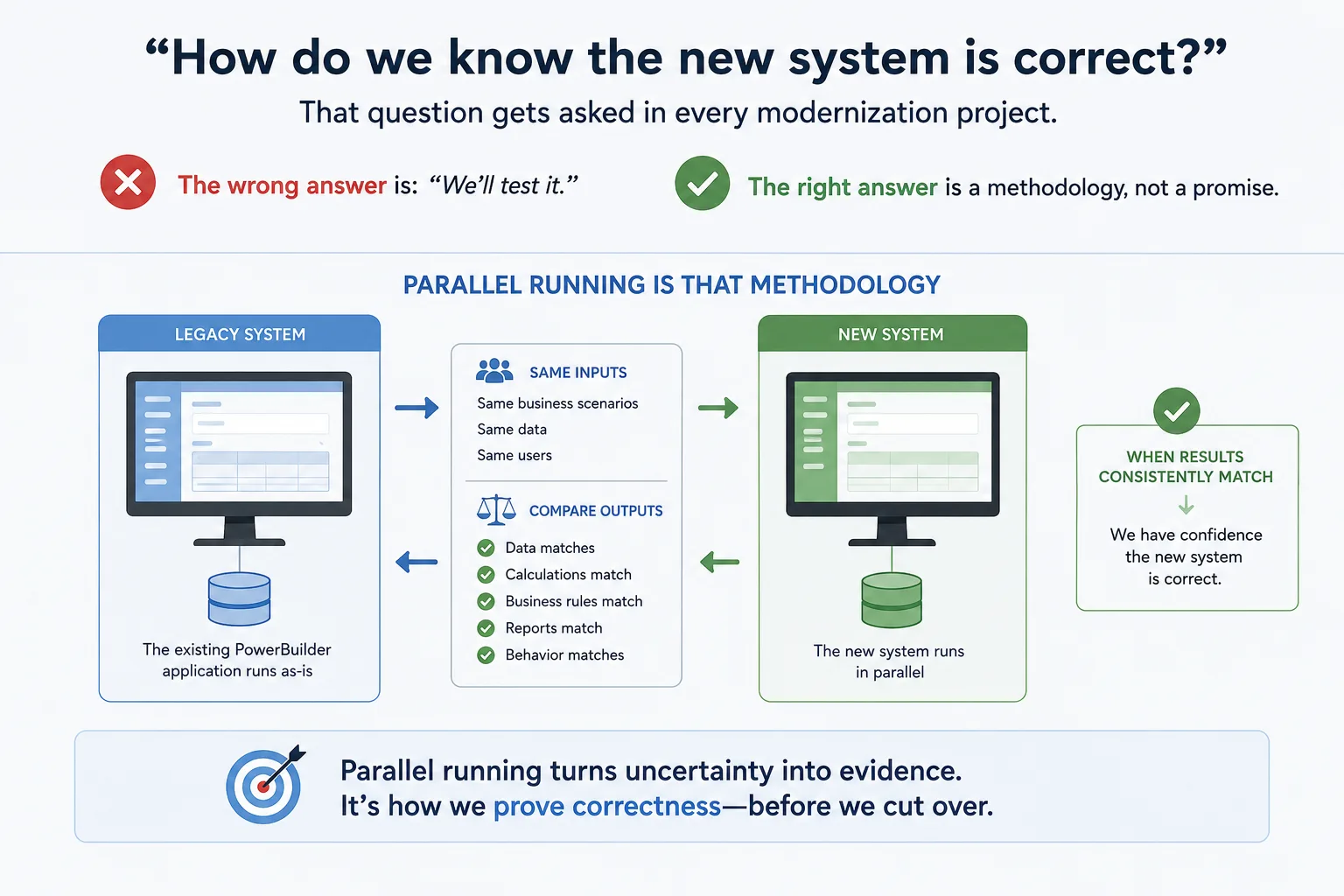
“How do we know the new system is correct?”
That question gets asked in every modernization project. The wrong answer is: “We’ll test it.” The right answer is a methodology, not a promise.
Parallel running is that methodology.
Here is how it works in practice:
Phase 1 — regression harness before migration begins. An automated test harness drives both the original PowerBuilder application and the new API with identical inputs and compares their outputs — retrieve results, computed column values, validation outcomes. Every divergence is a defect. No module moves forward until outputs match completely.
Phase 2 — shadow mode in production. As each module is migrated, a subset of real production transactions is processed by both systems simultaneously. The legacy system’s output is authoritative. The new system runs alongside it, silent, proving its behavior under conditions no test environment fully replicates.
Phase 3 — gradual promotion. Only when a module is demonstrably stable in shadow mode — with zero divergence over a meaningful transaction volume — does it get promoted to primary status and its legacy equivalent retired.
The result: a cutover that is never a single event.
Each module earns its promotion individually.
No single night when everything is at risk
Parallel running is not a precaution. It is the only systematic proof that the migration worked.
You can find relevant information in the specific section: https://enable-dev.com/modernization
Follow us on LinkedIn.