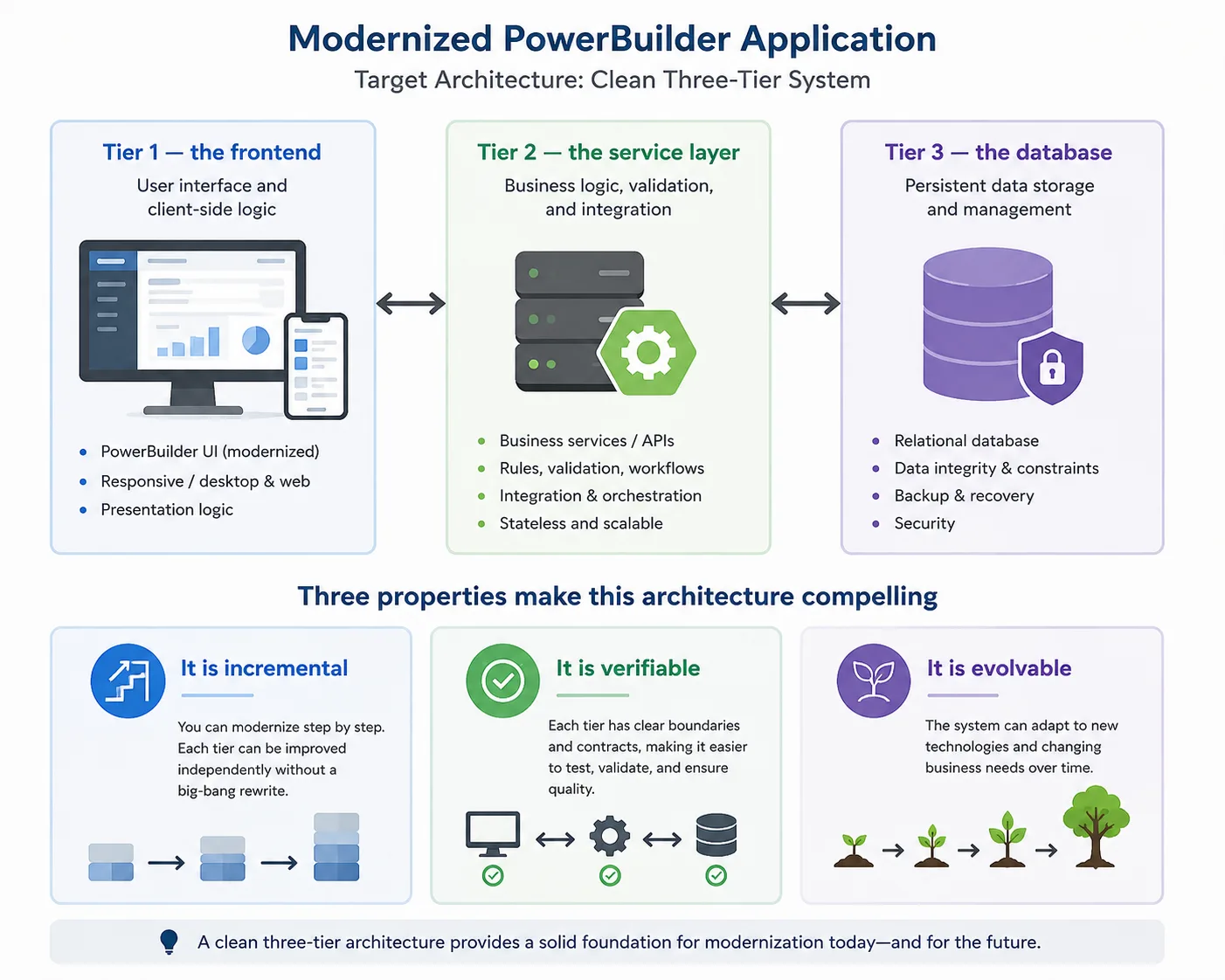
The target architecture for a modernized PowerBuilder application is a clean three-tier system.
Tier 1 — the frontend: A React or Angular single-page application, served from a CDN. Fully responsive — works on a 375px phone screen, a tablet, and also a widescreen monitor. Furthermore communicates with the backend exclusively through HTTPS API calls. A React Native or Flutter app shares the same API surface for mobile.
Tier 2 — the service layer: An ASP.NET Core application, containerized, deployed in Kubernetes or Azure App Service. Hosts a versioned REST API secured with OAuth 2.0. Each controller maps to a functional domain — accounts, orders, reporting — and internally uses .NET DataStore objects to execute the business logic originally contained in PowerBuilder DataWindows. Secured with JWT, fine-grained authorization via ASP.NET Core policies.
Tier 3 — the database: Preserved as-is during the initial migration to ensure continuity. The existing relational database — SQL Server, Oracle, DB2 — continues as the system of record. Schema changes are introduced once the application layer reaches stability.
Three properties make this architecture compelling:
It is incremental — individual DataWindow objects migrate one at a time while the rest continue running in the legacy application.
It’s verifiable — the DataStore and the original app run against the same inputs, with outputs compared automatically.
It’s evolvable — once logic runs in .NET, it can be refactored into handwritten C# service classes wherever business value justifies it.
You can find relevant information in the specific section: https://enable-dev.com/modernization
Follow us on LinkedIn.